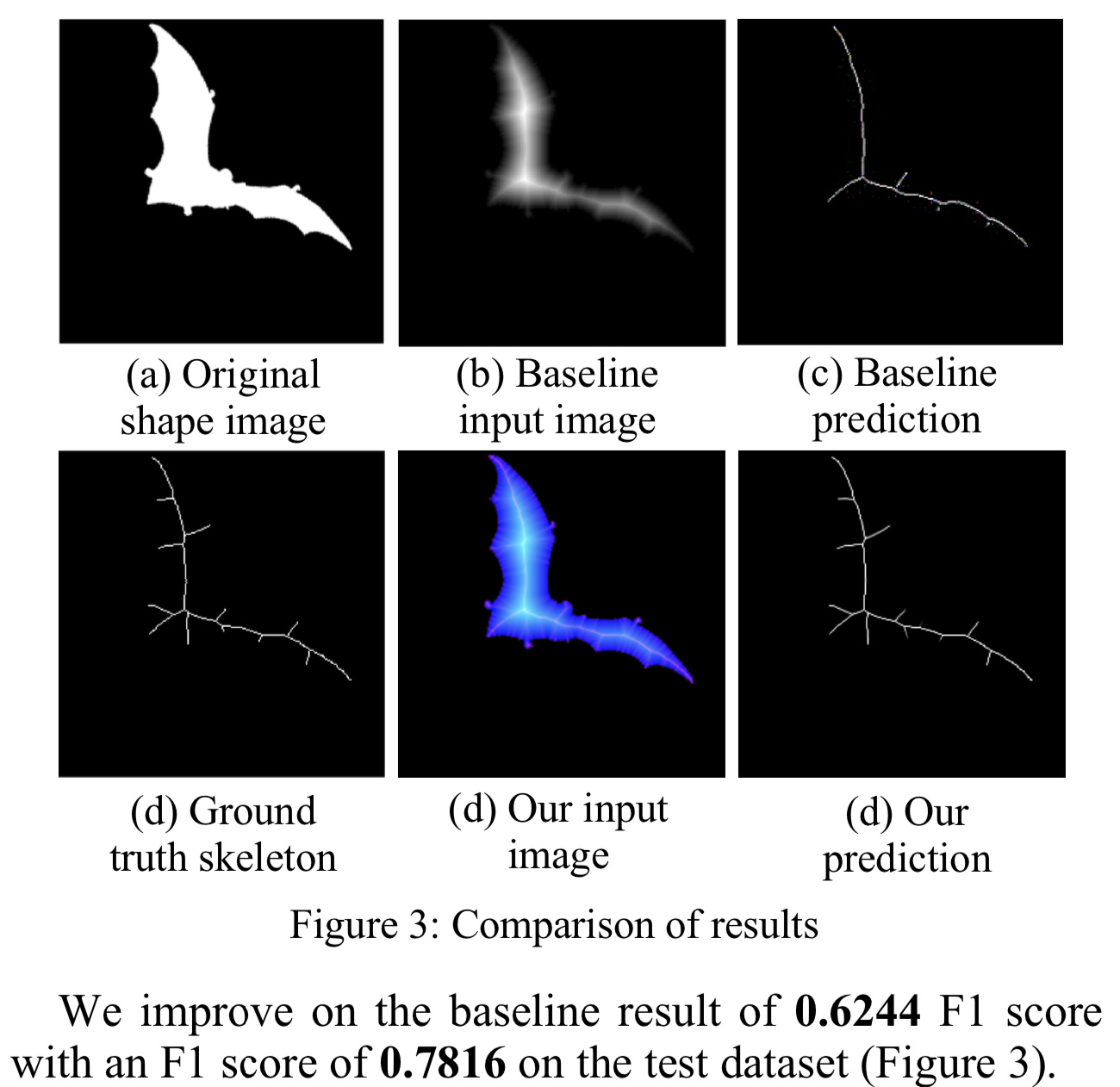
I recently competed in a CVPR 2019 Workshop challenge, segmenting skeletons from 2 dimensional binary shapes. Using an image distance transform from a 2007 paper combined with “out of the box” fast.ai U-Nets, I managed 1st and 2nd places respectively in 2 of the 3 challenge tracks. Thanks to fast.ai for the tools to compete in professional computer vision conference challenges! 14 months ago I’d never done any ML/DL/python or maths beyond high school. Awesome fast.ai.
It was interesting to participate in an academic challenge where a paper also had to be submitted. In my non-ML/DL/DS day job the pursuit is to combine cheap, supportable, proven, flexible building blocks most effectively. Isn’t that the goal in most jobs? But in paper review terms that is known as “reject - no significant novelty is introduced”. No wonder when I’m looking for a solution I avoid the deluge of dubious academic papers but instead turn to blog/forum posts of practical implementations and spend my time trying to understand the dataset, not implement last week’s networks.